
This project began as an exploration of DeKalb Fire Department’s budding community paramedicine program. Then DeKalb fire chief Luke Howieson pointed me to a related document our local hospital publishes. Suddenly the analysis seemed incomplete without a larger picture of emergency medicine and paramedicine, with inclusion of Northwestern Medicine facilities Kishwaukee Hospital and Ben Gordon Center specifically.
Mission and scope of the outreach practiced by the agencies differ, as do the amounts and types of resources each can summon for the purpose. But the reason for the growth of community paramedicine and prevention programs in both settings is the same: to find ways to drive down emergency call volume, so that each patient is timely and properly treated.
Northwestern Medicine Kishwaukee Hospital (Kish) Outreach
Kish builds and amends prevention-based outreach programs based on the Community Health Needs Assessment (CHNA), a report about its service area and the health priorities within it. Here’s that 34,000 figure from the title of this post in context, from the 2024 CHNA:
Located in DeKalb, Illinois, Northwestern Medicine Kishwaukee Hospital is an acute-care, 98-bed community hospital…Due to the low ratio of primary care physicians and advanced practice providers to residents in DeKalb County, portions of the county have been designated by the federal government as a Medically Underserved Population (MUP). Northwestern Medicine Kishwaukee Hospital provides much-needed access to quality health care in its community. In fiscal year 2023 (FY23), the medical staff of 349 physicians treated patients through more than 5,600 inpatient admissions and nearly 34,000 emergency department visits.
The described community service area covers 11 zip codes in DeKalb County and serves a bit fewer than 90,000 people. The reported 34,000 emergency department (ED) visits, then, come to about 377 visits per 1,000 people. For comparison’s sake, Illinois’ 2024 estimated state average is 404 visits per 1,000 population (which would equal some 36,000 total visits for 90,000 population) and the national average is 422 per 1,000 (equal to almost 38,000 total visits for 90,000 population).
At any rate, the needs assessment ultimately helps Kish — along with a collection of local service organizations Kish has named the Community Resource Council — to focus on a healthcare equivalent of a diversion program from ED visits. This not only benefits patients but also helps mitigate the continual threat of systemic overwhelm from the dual issues of call volume and staff shortages. Current priorities in achieving this are access to healthcare, behavioral health, and cardiovascular disease; health screenings, classes, and funding of other local resources are implemented to meet the priority goals.
Northwestern offers at least two newish (begun this decade) behavioral health programs that help to divert from the EMS system. One is The Living Room at Northwestern Medicine Ben Gordon Center, a walk-in arrangement for adults to address personal crises with professional support without trips to the ED. Northwestern’s opening of the space was a goal identified in its 2021 CHNA. In 2023, its first full year, it served 967 clients.
Another resource, again via Northwestern’s Ben Gordon Center, is a social worker liaison program for local police departments. In DeKalb PD’s case, the program evolved into a contract involving embedded social workers last year.
DeKalb and Community Paramedicine
DeKalb FD’s contribution to Kish’s 34,000 ED visits in 2023 was 4,283 ambulance transports to the hospital.
But it’s only part of the department’s story for that year. The 4,283 transports came out of 6,215 patient interactions arising from 6,318 calls for medical services. And the total call volume was an unprecedented 7,684 calls for services of all kinds, a 32% increase over 2013. High volume can present a danger of too many simultaneous and overlapping calls, which interferes with timely response.
The good news is, because 6,318 calls for emergency medical services “only” resulted in 4,283 transports to the hospital, it indicates not all the EMS calls were emergencies. This leaves potential space for call volume reduction via paramedicine activities.
A model for non-emergency interactions already exists: fire departments and districts typically perform safety inspections and other fire and accident prevention. Community paramedicine programs likewise take steps to help reduce the need for EMS, often, it appears, taking the form of individualized problem-solving. The paramedicine designation allows emergency personnel to offer non-urgent care, which might mean connecting patients to primary medical or preventive services, or referring them to in-house efforts – one example, mentioned previously, is Bloomington’s community risk reduction program, which is focusing this year on preventing falls in residents’ homes.
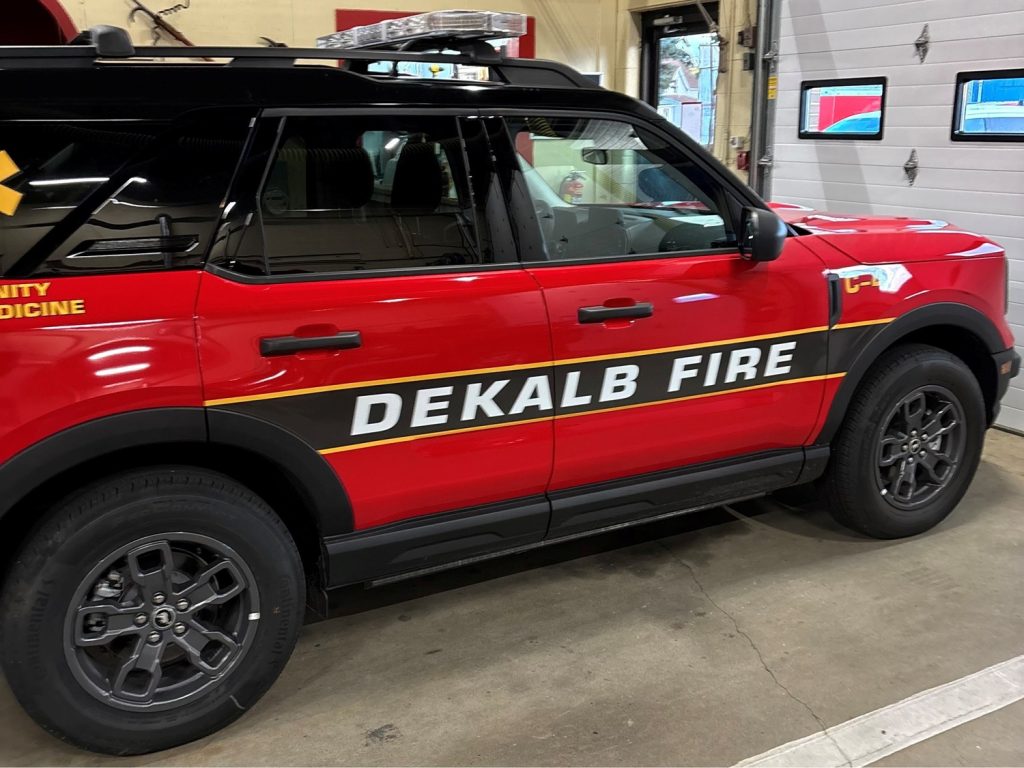
DeKalb recently obtained a shiny red Bronco to use for paramedicine. However, the concept is not new to the city. They’ve driven this direction since 2021, when an “EMS Lieutenant” position was added to the city’s labor contract with IAFF. Part of the EMS Lieutenant’s job is “acting as liaison with the regional EMS bodies,” which of course includes Northwestern Medicine Kishwaukee Hospital.
The program began in fits and starts, though, because originally the idea was largely tied to state legislation to allow reimbursements for lift assists; the legislation moved glacially, and wasn’t enacted until this year.
Nevertheless, DeKalb FD has been picking up the pace. Often this means finding resources for the “frequent flyers,” which refers to residents who phone 911 repeatedly for issues that are serious, but not actual emergencies. From the FD’s 2023 annual report:
Many times we are called to assist individuals who are unable to leave or return to their homes because of mobility issues. Because this can tie up resources needed elsewhere our goal has been to get the patient referred to the appropriate organizations to obtain resources in an effort to help with their mobility issues. Our referrals include services like Elder Care, RAMP and the DeKalb County Housing Authority.
Addressing costs is particularly important. The city expects to spend $18 million to provide all FD services in 2026, which makes up some 32% of DeKalb’s general operating budget. The opening of a fourth fire station and continued new hiring for it compound the financial pressure – one ominous sign is DeKalb’s plan to use $100,000 of reserve funds to make repairs to older stations this year. But the department appears sensitive to the financial issues, with its pursuit of lift assist reimbursements as one example.
GEMT reimbursements, which cover the difference between the actual cost of ambulance transports and what Medicaid reimburses, are another important source of revenue. So far, the funds have mostly gone to replacing FD vehicles and equipment, but Howieson has confirmed for me that GEMT money also can be pushed toward personnel expenses when needed.
Additionally, the Bronco and related equipment for paramedicine speak to the FD’s grant-writing efforts. The department obtained them last year thanks to a grant funded by the Howard and Mildred Eychaner Fund and awarded by DeKalb County Community Foundation, which also has supplied a multi-year grant to Elder Care Services to help reimburse agencies for mobility assistance.
The city’s moves toward partnerships and referrals are part of a holistic approach called community integrated health or mobile integrated health. CIH/MIH emphasizes collaboration in helping patients meet their needs and you will sometimes see the term paired with the names of local paramedicine programs.
Progress, and More to Come
Reports to this point are encouraging. Howieson has commented, “In one case, we were able to connect a patient with the right services and reduce 911 calls from 73 in one year to zero.” Sometimes the solution is to install a ramp, another time more appropriate housing might be the answer.
In the area of mental health, Howieson praises The Living Room at Northwestern Medicine Ben Gordon Center as a much-needed resource. He says the FD also is contemplating the possibility of partnering with social workers on calls where appropriate, a la DeKalb Police.
The FD’s next annual report and presentation are expected to land on DeKalb’s city council agenda for its regular meeting June 8. While it feels like early days yet, it’ll still be interesting to compare 2025 data to previous years, to see if we can discern impacts from increased paramedicine practice in our city.
We’re going to need results. The next hit to the healthcare system comes this year, with another anticipated rise in emergency department volumes due to the expiration of Affordable Care Act premium tax credits and Medicaid cuts.